
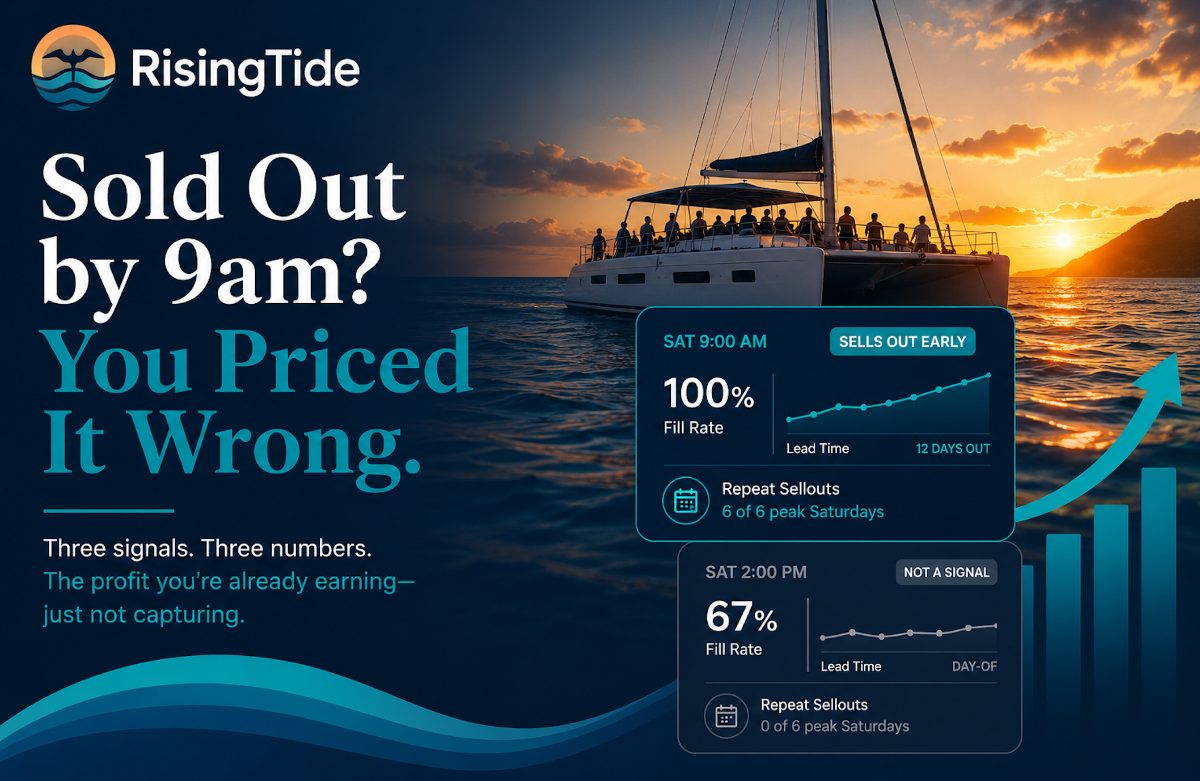
Sold Out by 9am? You Priced It Wrong
Selling out fast feels like winning. It's actually the most expensive mistake an operator can make.
Sold Out by 9am? You Priced It Wrong
2026-07-30th · Revenue Management ·
Selling out fast feels like winning. It's actually the most expensive mistake an operator can make.
A sellout tells you one thing only. It tells you demand was at least as high as your price. It never tells you how much higher it could have gone. A full boat at a flat price is the one outcome that hides its own ceiling.
A sellout is a one-way signal
Start with the slot that doesn't sell out.
Say your Wednesday morning snorkel fills to 60% and stops. You've learned something precise. At this price, demand ran out before your seats did. The number tells you exactly where you stand.
Now take the slot that sells out. What did you learn? Almost nothing. Only that demand met or beat your price. The faster it cleared, the more room you probably left on the table, but you can't see how much, because the boat was full before you found out.
That's the trap. The cost is invisible. The boat was full, the day went fine, the money looked good, so nobody fixes it. The same slot stays underpriced season after season, because a full boat never looks like a problem.
The non-sellout shows you its limit. The sellout hides it. To find the hidden ceiling, read these three signals.
Signal 1 — Lead time is compressing
The first signal is lead time.
Watch the trend, not the number. If a slot used to fill the week of and now it's gone ten days out, demand is outrunning supply at the price you set. Lead time moves before fill rate maxes out. It's the early-warning light.
If your whole calendar is filling earlier, that's the season. Good weather, a strong year, more visitors. But if one slot pulls ahead while the others hold steady, that's not the season. That's the price. Compressing lead time on a single slot separates a price problem from a season problem. It's a clear signal.
Signal 2 — Fill rate is pinned at the top
The second signal is fill rate.
As an industry rule of thumb, commonly cited rather than hard research, operators aim for roughly 80 to 90% utilization on peak dates and 60 to 70% off-peak. A load factor above 70% is generally called "good," around 75% "excellent." Treat those as ballpark, not law.
Here's the read. A peak slot that brushes the top of that band now and then is well-priced. A peak slot pinned there every peak date, or flatly hitting 100% and selling out every time, isn't sitting at a healthy ceiling. It's past it.
Fill rate alone can fool you, though. A high fill rate could just mean a great season. So pair it with Signal 1. High fill rate on its own is maybe luck. High fill rate plus compressing lead time is mispricing.
Signal 3 — The same slot sells out, week after week
The third signal is repetition.
One sellout is a data point. The same slot clearing early every peak Saturday is a standing instruction you keep ignoring.
Repetition kills the "lucky weekend" excuse. If a slot sold out once, fine, maybe a group booked late or the weather broke your way. If it clears early every peak Saturday for six weeks running, the market has told you the same thing six times. That's a pattern.
It's also the safest slot to test a higher price on. You're not raising into a guess. You're raising into demand that's been proven again and again.
A worked example — the Signal Scorecard
Say an operator runs the same activity at two times on a Saturday. Both priced flat, both the same rate. Twenty-four seats per departure. Flat price: $75.
Run both through the three signals, side by side. The last six peak Saturdays:
| Signal | Slot A — Sat 9:00 a.m. | Slot B — Sat 2:00 p.m. |
| Avg fill rate | 24 of 24 = 100% | 16 of 24 = 67% |
| Lead time trend | Fills ~10–12 days out, was ~3 days last year. Compressing | Fills day-of or not at all. Flat |
| Repeat sellouts | 6 of 6 | 0 of 6 |
Slot A. It's pinned at 100%. It clears earlier every week. And it's done that six weeks running. All three signals point the same way: underpriced. The flat $75 is below what the 9 a.m. slot would clear at. You can't see the ceiling because the boat is full before you reach it.
Slot B. None of the three signals are firing. Fill rate sits at 67%, not pinned at capacity. Lead time isn't compressing. It has sold out zero of the last six peak Saturdays. That's why you leave it alone. Not because 67% lands in some "right" band, but because the slot isn't sending any of the signals that say "raise me." Cutting its price would just give away margin on seats, some of which sell anyway.
So make one move, not two. Raise Slot A in a step, not a leap. Say to $85. That's $10 on $75, about 13%. Do it on the next peak Saturday and watch the same three numbers.
- If it still sells out and still clears early, the ceiling is higher still. Step again.
- If lead time stretches back out and fill rate eases toward the upper 80s, you've found a healthier price. Full enough to be efficient, not so full it's leaving money behind.
Leave Slot B alone. The discipline is per-slot, not per-activity. The same tour can be underpriced at 9 a.m. and fairly priced at 2 p.m. A single flat price hides both.
What the signals don't tell you
The signals tell you where there's headroom. They don't tell you the exact ceiling, and they never mean "raise until it stops selling." A slot can soften at a higher price. That's why you raise incrementally, not in one jump.
And a single hot date can fake a signal. A festival weekend, a big group, a stretch of perfect weather. Any of those can light up one number for one date. So look for the pattern, not the date. Lead time and fill rate and repeat sellouts pointing the same way, over several peak dates, is a signal. One busy Saturday is not. This is where a true revenue manager maker their impact.
The full boat felt like the win The speed it filled was the bill
That's the whole reframe. Charging more when the signals say you can is what dynamic pricing enables. It is not slashing prices to fill seats. It's reading the demand you already have and pricing into it.
You don't raise blind, either. You set a floor and a ceiling, and the price only moves inside them. You set the boundaries, Rev manages the rest. If you want to learn more about how RisingTide and "Rev" can help improve signal and implement that into your pricing live; send us a note!
Get insights like this in your inbox
Revenue strategy, pricing tactics, and data from the experiences economy – delivered to operators who want to stay ahead.