
Let Rev Optimize your Pricing
Most operators don't object to dynamic pricing. They object to losing control of their own prices. So lets breakdown the real concerns around dynamic pricing. The first: "How do I trust that the price is based on the best signal?" The second: "Can I control the boundary conditions so the price doesn't move too high or low?"
Set the Floor and the Ceiling, Then Let Rev Optimize your Pricing
2026-08-21 · Revenue Management ·
Most operators don't object to dynamic pricing. They object to losing control of their own prices. So lets breakdown the real concerns around dynamic pricing. The first: "How do I trust that the price is based on the best signal?" The second: "Can I control the boundary conditions so the price doesn't move too high or low?" These are valid concerns and we see them patterned across many of the tour operators that we meet with. So we decided it would be best for everyone if we breakdown and allay those concerns here.
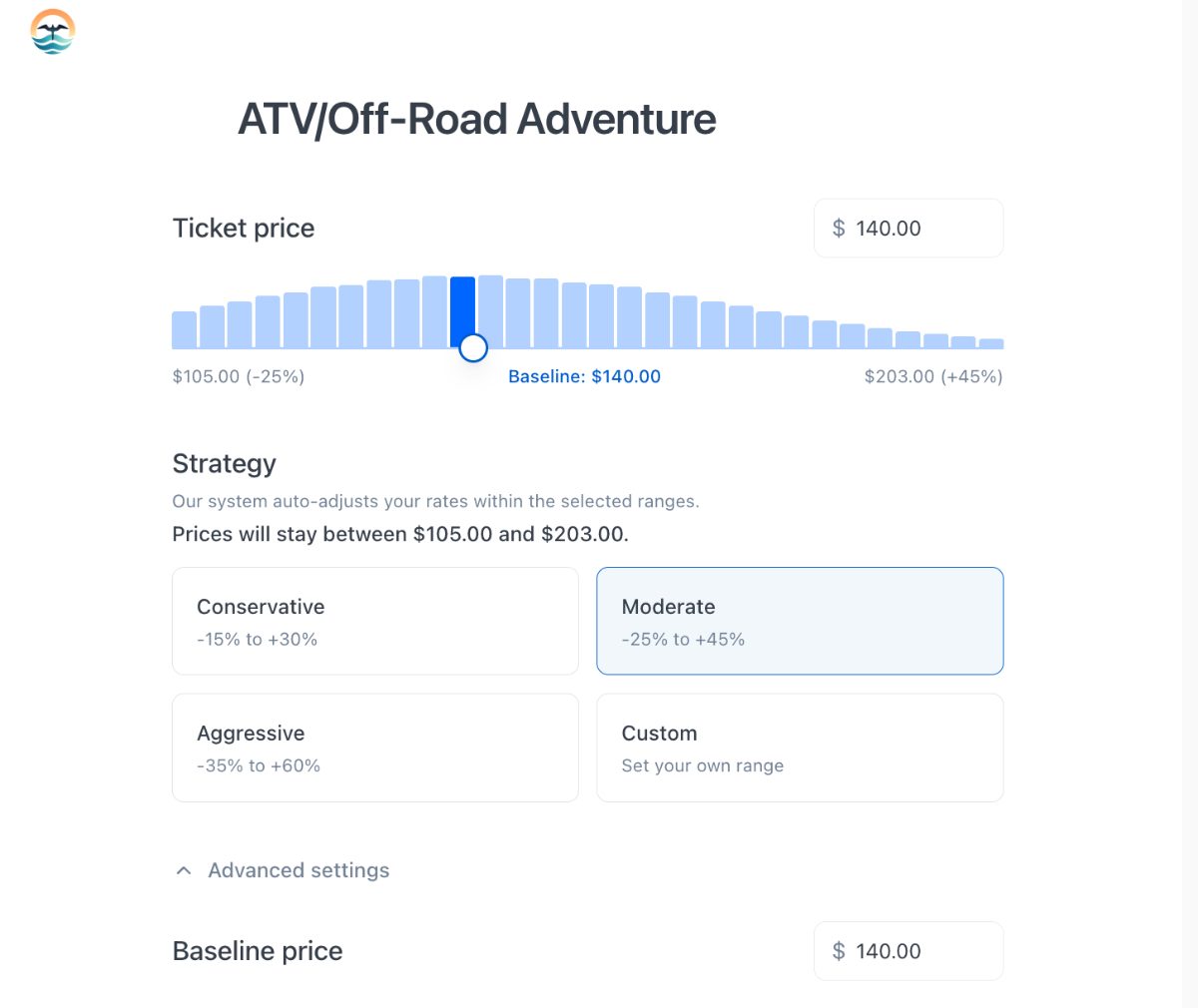
The theme driving these concerns is really control. An operator wants to retain control without having to spend the time daily analyzing and manipulating price as things change. The way we set our system up is customized railing. Railings are the boundaries set by the operator based on the baseline price for a specific seat. Then Rev will make incremental changes up or down within the railings.
What is a railing
Let's break it down, a railing is two numbers. A floor, the lowest price a seat will ever sell at. And a ceiling, the highest price a seat will ever sell for. The price moves freely between those two boundaries. Rev cannot cross either one.
The floor protects your margin and your brand. It's the number below which you'd rather hold the seat empty than sell it. The ceiling caps the top. It's the number above which you decide not to chase the extra dollar, for guest goodwill, for your company reputation, or just for your own comfort.
You already carry both numbers in your head. You know the price you'd never go below. You know the price that would feel wrong to charge. Every operator does. A railing sets and enforces them, automatically, every minute of every day, including the hours you're asleep.
Why this gives Operators control
Most of the pricing pitch in this category sounds the same: autonomous, set-it-and-forget-it, the system decides. That asks you to trust something you can't see. You hand over the keys and hope.
Railings flip the trust model. You decide the two numbers that matter most which creates the railings. The only thing automated is the movement between lines you drew yourself. The boundaries are yours. The busywork inside them is the only part you delegate to Rev.
The question was never whether you trust the algorithm. It's whether you trust your own floor and ceiling, and you set both.
The two presets: conservative vs aggressive
Once your railings are set, you pick how boldly the price moves between them. There are two presets: conservative and aggressive.
Conservative moves in smaller steps. It's slower to chase a peak and sits lower in the band. It's for the operator who wants to dip a toe, keep the price close to where it's always been, and let it drift up only when demand is clearly there.
Aggressive moves in bigger steps. It pushes toward the ceiling faster when demand is hot. It's for the operator ready to capture peak days more fully.
Here's the part that matters most: both presets live entirely inside the same railings. Aggressive isn't reckless. The ceiling still caps it. No setting lets the price escape the two lines you drew. Nothing overrides the floor and ceiling.
That's also the on-ramp for the skeptic. Start conservative, with a tight band. Watch what it does against the baseline. As trust builds, widen the band and switch to aggressive. You're never out of control at any step, because both ends are always capped by you.
Worked example: one activity
Let me walk one activity through it. This is a hypothetical example with round numbers, not a result we observed, just a picture you can map onto your own pricing. Say you run a sunset sail. You set your floor at $70 and your ceiling at $120. Those are your two lines.
On a slow Tuesday, demand is soft. The price sits mid-band, call it $85. Above the floor, well below the ceiling. You're not giving the seat away, and you're not pretending it's a peak night.
On a peak Saturday, demand is hot. The price climbs toward the ceiling, call it $115. Close to your $120 line, but never past it.
Look at your downside. On the worst day, the price can't fall below $70. On the best day, it can't run past $120. You drew both lines. The price moved between them, which is the whole point, but it never went anywhere you didn't allow.
That's it. Two numbers you set, and the in-between handled for you.
What dynamic pricing truly drives
Railings aren't only defensive. The same lines that protect your downside are what let you raise your price safely. A flat price is an invisible ceiling. If you never move off one number, every peak Saturday leaves money on the table, and you'd never know, because nothing was tracked moving against it.
How much does that matter? Consider the pricing lever. This is a cross-industry finding from S&P 1500 companies, the principle, not a tours benchmark: a 1% improvement in price lifts operating profit by roughly 8% at constant volume. That's nearly 50% more than a 1% cut in variable costs, and more than three times the lift from selling 1% more volume.
The other direction is brutal. To make up for a 5% price cut, you'd need volume to rise about 18.7% just to hold profit flat. That's why discounting to chase heads-in-seats so rarely pencils out. The floor limits the extent of any cutting. The ceiling lets your revenue and profits climb.
The control story and the yield story are the same story. Railings let you raise safely, because the floor guarantees you never overshoot downward.
Close
You keep the decisions that matter: the floor, the ceiling, and how boldly the price moves between them. You hand off only the minute-to-minute adjusting in the middle, the part you don't have time to do by hand and shouldn't have to.
That's the trade. Two numbers, drawn by you. The busywork between them, off your plate. You were never afraid of the price moving. You were afraid of it moving without you. Now it can't.
Set your railings in 2 minutes.
Sources
- McKinsey & Company. "The power of pricing." https://www.mckinsey.com/capabilities/growth-marketing-and-sales/our-insights/the-power-of-pricing
- Arival. "Dynamic pricing to more than double." https://arival.travel/article/dynamic-pricing-to-more-than-double/
Get insights like this in your inbox
Revenue strategy, pricing tactics, and data from the experiences economy – delivered to operators who want to stay ahead.