
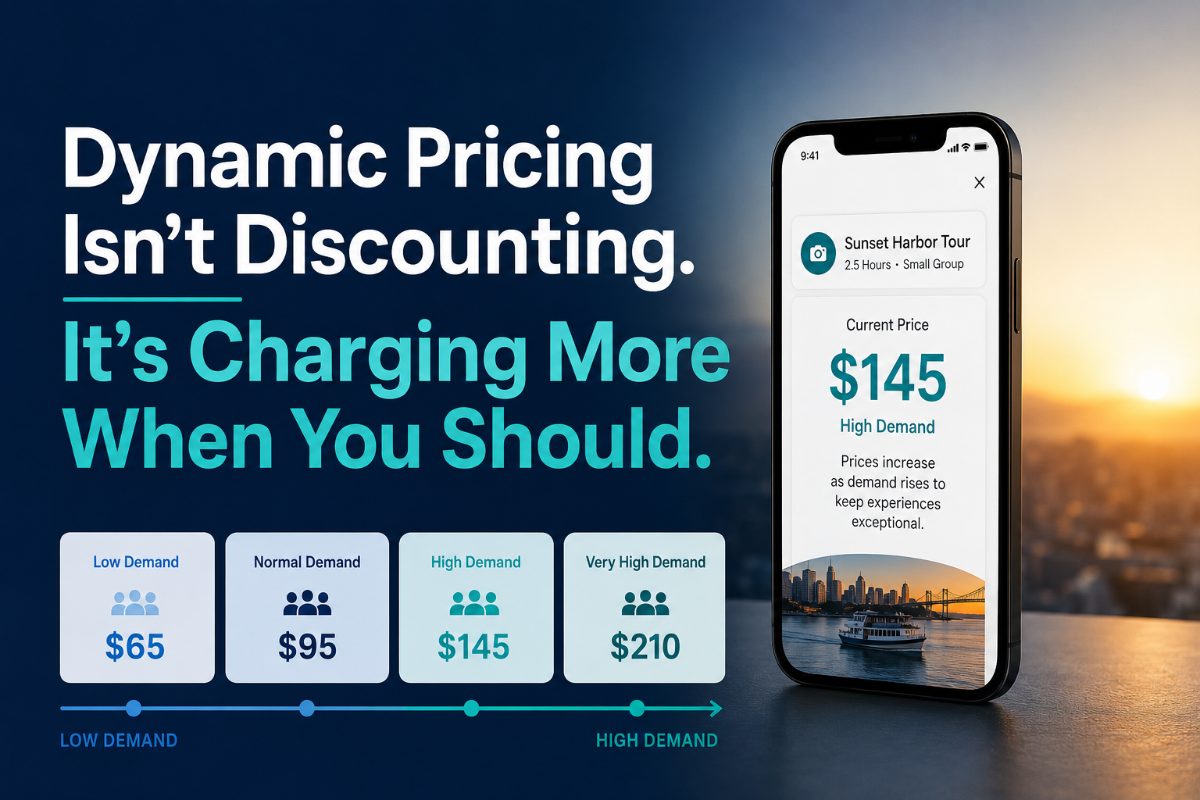
Dynamic Pricing Isn't Discounting It's Charging More When You Should
Dynamic pricing done right moves yield up, not price down
2026-07-07 · Revenue Management
You sold out your 9 a.m. zipline three Saturdays running. You felt good about it. You shouldn't have. A sellout at a price you set in 2023 isn't a win — it's a receipt for the money you left on the counter.
When most operators hear "dynamic pricing," they brace for one of two things. Either it's surge pricing — the thing that triples your ride home in a rainstorm — or it's the discount treadmill, where you shave a few dollars to win the OTA listing and then can't climb back up. Both fears are real. Neither is what this is.
The thesis, plain: dynamic pricing done right moves yield up, not price down. It's not about punishing customers when demand spikes. It's about not selling your best inventory at your worst price. The Saturday morning slot that books out by Tuesday is not the same product as the Wednesday afternoon slot you're praying fills. Charging the same for both is a decision — and right now, for most operators, it's a decision made by accident.
Let's do the math on what that accident costs.
The new math
Take a 40-seat tour. It sells out 12 Saturdays in a row at a flat $89. Good season. Full boats, happy crew.
Now suppose demand on those Saturdays would actually clear at $109. People were willing to pay it. You just never asked.
The gap is $20 a seat. On a 40-seat boat, that's $800 every Saturday. Across 12 Saturdays, that's $9,600.
Run it the other way to be sure. Twelve sold-out Saturdays at $89 is $42,720. The same twelve at $109 is $52,320. The difference is $9,600. Same number.
That $9,600 is not new demand. It's not customers you went out and found. It's money sitting inside bookings you already had — confirmed sellouts, butts in seats, the season you already ran.
Now the honest part. This holds only if all 40 seats still sell at $109. They do here, because the premise was that demand would clear at $109. If demand softens at the higher price, the math changes, and you'd want a tool that catches that and backs off. That's the whole point of doing this with intelligence instead of a hunch.
"Twelve Saturdays" is one summer season here. Your number of peak dates is your own — maybe eight, maybe twenty, maybe every Saturday plus the two weeks around a festival. Run the same arithmetic on your own calendar. The seats per departure, the spread between what you charge and what the day would clear at, the number of dates it sells out. Those three numbers are the whole model, and you already know all three.
And $20 on $89 is a +22.5% move. Treat it as a sanity check, not the argument. The argument is simpler: you left $9,600 on the counter and called it a sellout.
Your customers already told you this
Operators talk themselves out of this. They assume the $89 price is the price because that's what people will pay, full stop. The data says otherwise — when you give people the option to pay more for something better, a large share take it.
Arival surveyed 668 attractions worldwide and asked their customers what they'd choose. One in three — 36% — picked a premium ticket priced at least 10% above the standard walk-up rate, just for the flexibility of choosing their arrival time. One in four would pay an extra 25% for a skip-the-line or VIP experience. And this isn't fringe: 51% of attractions already offer some version of a skip-the-line or VIP tier.
Read that carefully, because it's easy to overstate. This is customers self-selecting into a better tier — flexibility, skip-the-line, VIP. It is not proof that the same customer will happily pay more for the exact same product on a busy Saturday. Those are different things.
But they come from the same instinct. A meaningful share of your customers want to pay more when paying more gets them something — a better time slot, a shorter line, a nicer seat. The headline from Arival's own research says it cleanest: one in three customers want to pay more, not less.
The mistake isn't charging too little. The mistake is offering one price, one tier, one experience, and assuming that's all anyone wants.
Why almost no one does it yet
If this math is so plain, why isn't everyone doing it?
Because almost no one is. Arival's numbers: only about 6% of attractions price dynamically. Another 17% use some form of variable pricing — different prices for different days or seasons, set by hand. Even among the big operators moving more than 500,000 guests a year, only about 12% price dynamically.
That's the wedge. Adoption is set to more than double. Right now you are early, and early is where the margin lives. The operators who figure out yield management before their market does aren't fighting over the same customers at a slightly lower price. They're capturing the surplus everyone else is leaving on the table.
In a few years this will be table stakes. The question is whether you're charging $109 on your sold-out Saturdays before your competitors are, or after they've already trained the market to expect it from somebody.
The part everyone gets wrong: control
Dynamic pricing fails when it feels like surge pricing. Random. Unfair. A number that jumps because some black box decided it should, with no explanation and no ceiling. That's the version customers hate, and they're right to.
The fix is control parameters. You deciding your strategy, and a machine optimizing your price within those parameters.
That's how Rising Tide is built. You set a floor and a ceiling — call them railings. Prices only ever move between the parameters you set. Your $89 tour never drops below the floor you're comfortable with, and never climbs past the ceiling you'd be embarrassed to charge. Inside those railings, the price adjusts to demand. Outside them, it can't, because you set the controls.
And before any price moves, you see the whole market — your competitors' live prices, in your market, right now. You're not guessing whether $109 is reasonable. You can see what the operator down the dock, or the county over, is charging for the same Saturday, and price into that with your eyes open.
So it's automated, but on your terms. The system does the monitoring and the adjusting. You set the boundaries and hold the visibility. That combination — control plus a live view of the market — is the difference between yield management and the surge pricing your customers would resent. One moves your revenue up inside parameters you decide. The other is a slot machine pointed at your reputation.
It's also where the floor earns its keep. Think about what a booking already costs you when it comes through an OTA — Viator takes ~25%, and up to 35%+ if you're on Accelerate. You don't always control that cut. You do control your floor. Setting it deliberately, instead of leaving an old price to coast, is the same instinct as not overpaying commission: protect the margin you can protect, and capture the upside on the days that hand it to you.
A different way to think about a sellout
This is the category shift: yield management, not a discount war. You are not racing anyone to the bottom. You are not shaving dollars to win a listing. You are charging what your inventory is worth on the day it's worth the most, and protecting your floor on the days it isn't.
Pricing your busiest Saturday like a rainy Tuesday — and then calling the sellout a success — is the mistake to leave behind. The full boat felt like a win. The receipt said otherwise. Once you've seen the $9,600, you can't unsee it, and you don't have to keep handing it back.
See what your competitors are charging in your market — live.
Sources
- Arival — What Visitors Want: Customer Segmentation & Variable Pricing: https://arival.travel/what-visitors-want-customer-segmentation-variable-pricing/
- Arival — Dynamic Pricing to More Than Double: https://arival.travel/article/dynamic-pricing-to-more-than-double/
- Samba — OTA Commission Rates (Supplier Guide): https://www.sambahq.com/ota-supplier-guide/ota-commission-rates
Get insights like this in your inbox
Revenue strategy, pricing tactics, and data from the experiences economy – delivered to operators who want to stay ahead.