
Benchmark Pricing
**Your Competitors' Prices Are Public. But Who Has Time to Check?**
Your Competitors' Prices Are Public But Who Has Time to Check?
2026-06-21 · Revenue Management ·
Here's the pain most operators carry: How am I priced against my competitor down the road? Most operators don't have the time to check the current rates their competitors are charging. Some even think that those prices are hidden. When in fact, they are publicly published.
The data is available, the simplicity is not
Every operator on any Reservation System; Peek, FareHarbor, Rezdy, or Singenuity is publishing a live price sheet, whether they think of it that way or not. The competitor down the dock isn't guarding his numbers. He's advertising them.
When you book a hotel, you check three others first. When you fly, you compare fares before you buy. You'd never book the first flight you saw. You do it without thinking.
You just never applied that habit to your business.
Why pricing blind costs you
Once you see the market, every pricing decision stops being a guess. Until then, it is one. Say your Saturday 9 a.m. tour is priced at $89. To be clear, that's a made-up number for the example, not anyone's real price. In a vacuum, you cannot tell if $89 is smart or a mistake. You're flying without instruments.
And flying blind has a cost that has nothing to do with matching anyone. You might be twenty percent under the market on your busiest Saturday and never know you left that money on the table. You might be the priciest option on a slow Tuesday and spend the season wondering why it won't fill.
That's the cost. Not that you failed to copy someone. That you couldn't see the instrument panel at all.
And almost nobody flies with instruments. Only about 6% of attractions price dynamically. Around 17% use variable pricing, which is manually hand-set by day or season. Enterprise attractions, the ones doing more than 500k guests a year, sit around 12% dynamic. Adoption is set to more than double. But read the numbers as they stand: the vast majority set one number and stop looking.
Now the guardrail. Seeing the market does not mean copying it. You might look at the whole field and decide to price above every one of them, because your experience is worth it. That's totally fine. Visibility is what turns that into a decision instead of an accident. You choose where you sit, above, below, or beside, and we are here to help with whatever strategy makes sense for you at that time.
"I don't have time to check 40 competitors every morning"
This is the fair objection. And it's correct.
Yes, the data is public. But public is not the same as easy. Checking it by hand means opening dozens of booking pages, one at a time. Again tomorrow, because prices and availability move. Across changing dates, because a Saturday in July is not a Tuesday in October, and holding all of it in your head well enough to compare.
That's real work. It's a job, and it's a job nobody running a tour operation has time for. So operators don't do it. Not because they can't see the market. Because reading the whole market by hand is a full-time task on top of the full-time job they already have. The door is open. Walking through it forty times a morning, by hand, is the part that doesn't work.
So the public data, by itself, doesn't help you. The market being visible only matters if reading it is something you can actually do. In less time than you have, across all the dates that matter, without it eating your morning.
That's the gap. The data is free. The reading is the work.
The market scorecard
That gap is what the market scorecard closes. This is the one place we'll name our own product: Rising Tide tracks competitors' live prices across the competitors in your segment and geography, then rolls that public-but-scattered data into one view that adds value to your business.
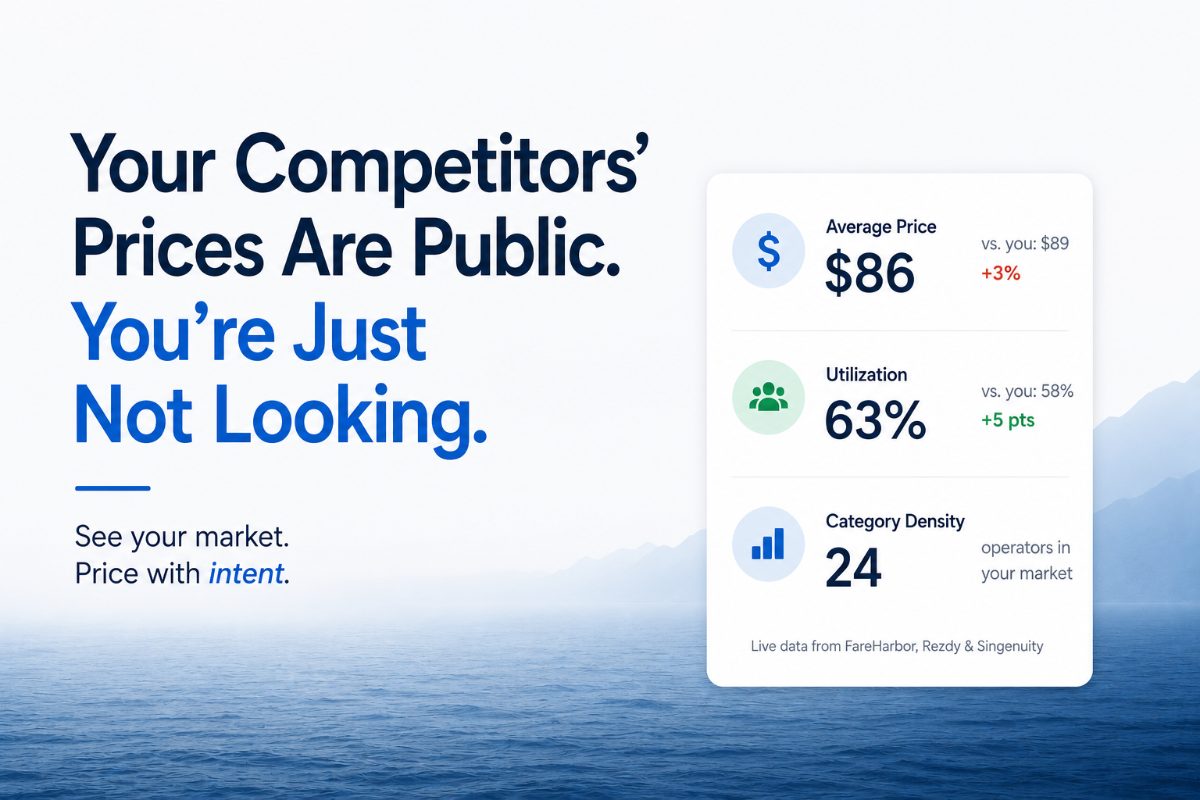
What you see: the average price in your market. Utilization, how full your competitors are running. Category density, how crowded your slice of the market actually is. The same numbers you could collect by hand across dozens of pages, gathered in one place, so you can read them instead of hunting for them.
A view into the market you were always allowed to see, with the manual part taken off your plate.
What it is not: an autopilot that matches the market for you. It doesn't move your prices to chase the operator down the dock. It shows you where you sit. You decide what to do about it. It pairs with setting your own rules, a floor and a ceiling you choose, so price only ever moves inside the lines you drew.
A window, not a steering wheel. You still drive.
Pricing in the open
The market was never a secret. It was just a lot of work to read it. . . until now.
Pricing in a vacuum was always a choice, and now it's a worse one. The data is sitting there in plain view, the way it always has been, and the work of reading all of it is solvable. The two reasons you had for guessing, "I can't see it" and "I can't read all of it," are both gone.
So this is the line the category splits on. Operators who can see the whole market price with intent. They know where they sit, and they decide on purpose. Everyone else is guessing, every morning, behind a door that was never locked.
You don't have to guess anymore.
Let us do the work, so you can focus on your customers.
Sources
- Arival, "Dynamic Pricing to More Than Double" — https://arival.travel/article/dynamic-pricing-to-more-than-double/
Get insights like this in your inbox
Revenue strategy, pricing tactics, and data from the experiences economy – delivered to operators who want to stay ahead.